Reflections on Matthew 22, Political Deception, and Ezekiel’s Jackals
Draw closer and pour from the Holy Grail. There’s an old maxim: “A little wine is good for the stomach.” But we must be careful what we consume. There is enough intoxication around us already. Some speculation needs us sober.
I have never considered myself particularly political, nor have I had much desire to enter the endless debates. Yet I want to be Christian and prophetic, and I am learning more and more that to be Christian is to be prophetic, and to be prophetic is, inevitably, to be political. So here I am, in the thick of the debate, eyeing my chalice and looking through the shades.
So how did I get here? Well, it started with a coin. I was studying Matthew 22, where Jesus is questioned about paying taxes to Caesar. The more I considered the encounter, the more the hypocrisy of those questioning him caught my attention. They sounded sincere enough, even flattering, while carefully setting a trap. With that still on my mind, I came across something Barack Obama said during his 2008 presidential campaign. Suddenly, the distance between that ancient encounter and our present political debates seemed remarkably small.
How is it that we can recognize deception, condemn it publicly, and then practise it when it serves our interests? And what happens when Christians become participants?
A Coin, a Question, and a Convenient Truth
In Matthew 22:15–22, the Pharisees devise a plan to trap Jesus in his words. They send their disciples, accompanied by the Herodians, to ask whether it is lawful to pay taxes to Caesar.
Their opening is remarkably courteous. They acknowledge Jesus as truthful, impartial, and faithful in teaching God’s way. What a glowing recommendation from people who have already decided to use his answer against him!
The question is politically dangerous. An answer against paying the imperial tax could expose Jesus to accusations of opposing Roman authority. An answer supporting it could alienate those who resented Roman domination. Their question concerns taxation. Their purpose concerns entrapment. Jesus recognizes the deception and calls them hypocrites.
That word has stayed with me.
The hypocrisy lies partly in the distance between their public speech and their private intention. They profess admiration for the very truthfulness they are attempting to exploit. Jesus asks for the coin used to pay the tax. They produce a denarius. He asks whose image and inscription it carries. Caesar’s.
Jesus responds by directing them to give Caesar what belongs to Caesar and God what belongs to God.
We have often used this passage to discuss the relationship between religion and government, the obligations of citizenship, and the limits of political authority. These are legitimate concerns. Yet the passage begins with something equally significant: people manipulating a public question for a purpose they are unwilling to disclose. And there is another thought worth entertaining. The coin bears Caesar’s image. According to Genesis 1:26–27, human beings bear God’s image. Matthew does not explicitly connect these two passages, but the theological possibility is difficult to ignore.
What happens when those who claim political authority forget the image borne by the people over whom they exercise it? What happens when human beings become instruments in a struggle for power?
An Old Warning with an Uncomfortable Familiarity
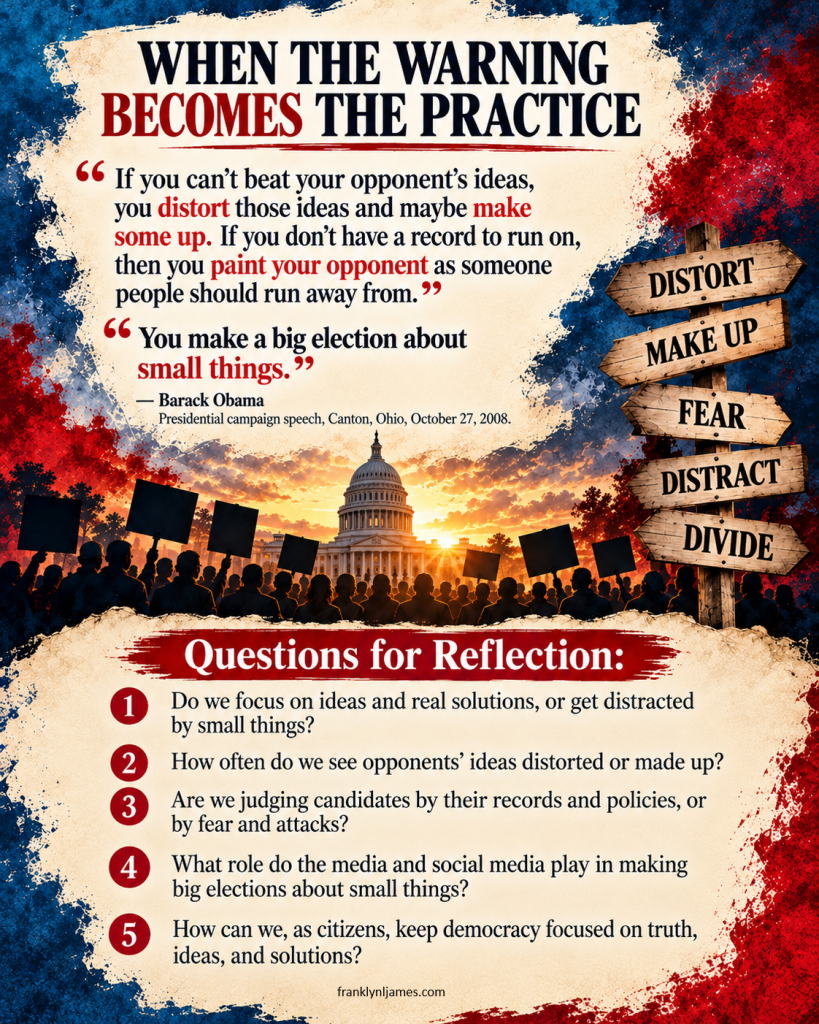
On October 27, 2008, during a campaign speech in Canton, Ohio, Barack Obama criticized the politics of distortion, personal attacks, and fear. He accused his opponent’s campaign of misrepresenting ideas and turning attention away from the substantive issues facing Americans. One sentence particularly caught my attention: “You make a big election about small things.” The full statement appears in the accompanying image.
Obama was arguing that politics should address the serious conditions affecting people’s lives. The United States was confronting a severe financial crisis, and he believed the campaign was becoming distracted by attacks and misrepresentations. Nearly two decades later, his words invite further examination.
Obama was himself a politician seeking power. His criticism of campaign tactics deserves consideration, but the ethical standard he articulated must apply equally to him, his political allies, and candidates and parties across the political spectrum. After all, this is hardly a problem confined to American politics.
That is where political loyalty can make us strangely selective. We recognize distortion when our opponents employ it. We demand accountability when another party misleads the public. Yet when a politician we favour uses questionable tactics, we sometimes become remarkably skilled at explaining why the circumstances are different. Apparently, truth can become inconvenient when our preferred candidate is speaking.
And we should interrogate the phrase “small things” itself. Who determines which issues are insignificant? Something dismissed as a distraction by the powerful may be a question of dignity, livelihood, or survival for someone else.
The problem is therefore more complicated than identifying a few troublesome politicians. We must examine the habits of political participation that make deception profitable and sometimes acceptable. Wherever public opinion can be manipulated through fear, distorted information, or manufactured hostility, the ethical question remains. When does a warning against deception become a description of our own behaviour?
Ezekiel’s Jackals and the Whitewashed Wall
That question drew me toward Ezekiel 13. The prophet condemns those who claim to speak for God while producing messages from their own imaginations. In verse 4, he describes the prophets as jackals among ruins. What an unsettling image! Jackals move among places of destruction, searching for what they can consume. Ezekiel’s accusation is especially severe because the prophets have failed to repair the breaches in Israel’s defences. They occupy positions of spiritual responsibility while neglecting the work of protecting the community.
The imagery develops further in Ezekiel 13:10–16.
A flimsy wall has been built, and the prophets cover it with whitewash. The appearance of strength conceals structural weakness. They announce peace where genuine peace is absent. The wall may look impressive. The danger remains. And in Ezekiel 22:27–28, the criticism becomes even more disturbing. Officials are compared to wolves who exploit the people, while the prophets cover their conduct with false assurances. Those entrusted with speaking truth become defenders of those who abuse power.
Ezekiel was addressing the failures of leadership in ancient Israel, within a particular religious and political setting. His words were not originally directed toward modern democratic elections. Nevertheless, his condemnation of deception and the misuse of authority raises questions that remain relevant.
- How often do we see institutions protecting appearances while neglecting the conditions beneath them?
- How often do leaders announce progress while refusing to acknowledge the people being harmed?
- And how often do religious voices provide the whitewash?
There is something especially troubling about a community that recognizes the cracks in its walls yet spends its energy defending the paint.
The Christians Among the Jackals
Now comes the question I find hardest to dismiss. Do Christians participate in the very deception that Jesus condemned and Ezekiel exposed?
I am thinking of Christians who sincerely profess faith in Jesus Christ, attend worship, pray, serve, and understand themselves as disciples.
- Can we participate in political dishonesty while continuing to speak the language of faith?
- Can we knowingly circulate falsehoods because they embarrass a political opponent?
- Can we condemn hatred in one political movement while excusing it in another?
- Can we demand integrity from public officials while defending those who violate the same standards whenever their policies suit our interests?
I believe we must acknowledge that Christians can participate in these practices. Religious commitment does not automatically protect anyone from dishonesty, prejudice, or misplaced loyalty.
There is also a distinction between being mistaken and deliberately deceiving others. We may sincerely believe something that turns out to be false. But what happens when credible evidence proves us wrong? Do we change our position, or do we continue repeating the claim because it serves our purposes? The latter brings us closer to the conduct the prophets condemned. And what of our churches?
When our political commitments influence which injustices we acknowledge, which victims receive our sympathy, or whose misconduct we are prepared to excuse, we have reason to examine what has happened to our moral judgment. Faith should sharpen our ethical responsibility. Yet religious language can sometimes become a shelter for conduct that would otherwise trouble our conscience.
Jesus offers a particularly sobering warning in Matthew 7:21–23. He speaks of people who call him Lord and point to extraordinary works done in his name. Yet his response includes the words, “I never knew you.” That passage should trouble anyone who assumes that religious profession alone settles the question of faithful discipleship.
I would be cautious about using Jesus’ warning in Matthew 7:21–23 to declare those whose politics differ from ours unworthy of Christ. Such judgments belong to God. The warning is searching enough when we allow it to examine our own faithfulness. We may speak passionately about God while resisting the truth God requires of us. We may defend the Christian name while behaving in ways that contradict the one whose name we bear. And perhaps the most troubling possibility is that we may do so without recognizing the contradiction.
The Questions We Cannot Afford to Avoid
The accompanying poster raises five questions about democracy. I find that they become even more demanding when placed before the church.
- Are we examining ideas, records, and genuine solutions, or allowing relatively minor controversies to consume our attention?
- How often do we encounter distorted accounts of political opponents, and how carefully do we examine them before accepting or repeating them?
- Are our judgments formed by evidence and public policy, or by fear and personal attacks?
- What responsibility do traditional media and social media bear for directing public attention toward political spectacle?
- And what can we, as citizens, do to keep public life accountable to truth?
These questions apply to voters, journalists, political parties, and public institutions. They also belong within our congregations. Christians have no obligation to agree on every political issue. Differences in economic policy, taxation, immigration, international relations, and the responsibilities of government can arise from serious ethical reflection.
Indeed, a healthy democracy needs disagreement.
But disagreement does not require deception, and political conviction does not excuse dishonesty. That is where the distinction matters.
A Christian may disagree profoundly with another person’s political judgment while remaining committed to representing that person’s position fairly. We should be able to challenge policies without inventing motives, expose wrongdoing without manufacturing evidence, and criticize leaders without denying their humanity. The challenge becomes sharper when the same expectations are applied to those we support.
When the Warning Becomes the Practice
I began with a coin.
Jesus was confronted by people who used the appearance of sincere inquiry to conceal an attempt at entrapment. Their question concerned Caesar, but their conduct exposed something about themselves. Obama’s 2008 warning brought that ancient encounter into conversation with contemporary political behaviour. Ezekiel then supplied the image I could not escape: jackals moving among ruins while those responsible for repairing the breaches offer assurances that all is well.
I am left wondering whether our difficulty is always a failure to recognize deception. Perhaps we sometimes recognize it quite clearly. We simply make room for it when it advances a cause we favour, embarrasses someone we oppose, or protects an institution to which we belong. And what does that say about our understanding of truth?
A democracy cannot require citizens to abandon their deepest convictions. It does, however, depend upon their willingness to distinguish conviction from falsehood and persuasion from manipulation.
For Christians, the question reaches further. What happens when loyalty to a political figure, party, or movement begins to exercise authority over the demands of discipleship? The coin in Matthew 22 carried Caesar’s image. The people holding it bore another. Perhaps that is where we should return whenever politics tempts us to reduce human beings to enemies, instruments, or votes.
The Holy Grail can return to its place on the shelf. Our cup of speculation is full enough. But one question remains, and I am not certain it will go down easily:
When the warning becomes the practice, are we among those repairing the breaches, or among those supplying the whitewash?
Sources
- Obama, Barack. “Remarks in Canton, Ohio Presenting Presidential Campaign ‘Closing Argument.’” October 27, 2008. The American Presidency Project.
- Sun-Times Wire. “Obama Closing Argument Speech: Transcript as Delivered.” October 27, 2008. Chicago Sun-Times.
- Weinberg, John. “The Great Recession and Its Aftermath.” Federal Reserve History.