What Do We Mean by Imperfect
Pour this one into a chalice and take it as it comes. We are asking whether Jesus was imperfect. The word itself deserves a little scrutiny. Conveniently, “imperfect” can mean human limitation in one sentence and moral guilt in the next, as though the two were the same. What kind of perfection allows a person to grow? If Jesus was without sin, what exactly are we claiming about his humanity? And what room does that leave for learning, struggle, and growth?
We need to distinguish tiredness, learning, and the strain of suffering from wrongdoing that calls for forgiveness. The New Testament presents Jesus as fully human and without sin. His humanity includes growth and vulnerability. His sinlessness means that these limits did not lead him into disobedience to God.
Yet some Gospel scenes make that claim difficult to hear. At Cana, Jesus responds to his mother with words that can sound abrupt in English. In Jerusalem, he overturns tables in the temple. Near Tyre, a port city on the Mediterranean coast north of Galilee, he compares giving Israel’s bread to outsiders with throwing the children’s food to dogs. A mother asking for her daughter’s healing is standing before him.
These passages deserve careful attention. Their difficulty should neither be brushed aside nor treated as proof of wrongdoing. This first post explores the difference between human limitation and moral failure. The second returns to the passages themselves.
One word with two meanings
“Imperfect” can describe a moral fault. Someone lies, acts cruelly, or withholds the care another person needs. It can also describe a person whose abilities are limited or still developing. A child who cannot reach the top shelf has a limit. She has committed no wrong by being small.
The same distinction matters when we speak about Jesus. Learning is different from deliberately deceiving someone. Needing rest is different from neglecting someone out of indifference. Feeling fear is different from betraying a responsibility because of it.
An argument becomes confused when “imperfect” changes meaning halfway through. Logicians call this equivocation: using one word in two different senses as though they were interchangeable. Consider the argument: Jesus grew in wisdom. Therefore, he was imperfect. Therefore, he could not have been sinless. The first conclusion means that Jesus was still developing. The second treats “imperfect” as morally guilty. Growth in wisdom does not establish guilt.
Hebrews makes the distinction especially clear. It says Jesus “learned obedience through what he suffered” and speaks of his being “made perfect” (Hebrews 5:8–9; see also 2:10). In Hebrews, “perfect” carries the sense of being brought to completion, reaching the end for which something exists. Read alongside the same letter’s declaration that he was without sin, “made perfect” concerns the completion of his saving work. Jesus lives out his obedience through suffering and carries his calling to its fulfilment.
A life can be sinless at every step and still have steps left to take.
The New Testament claim about sin
Jesus’ sinlessness appears in several strands of the New Testament. Hebrews describes him as tested as we are, “yet without sin” (4:15). Paul speaks of Christ as the one “who knew no sin” (2 Corinthians 5:21). First Peter says, “He committed no sin” (2:22), and First John states that “in him there is no sin” (3:5).
These statements are part of the New Testament’s account of who Jesus is and what his life and death accomplish. They are theological claims. They express the church’s faith about Jesus, and historical research alone cannot confirm or refute them. No historian can inspect every hour of someone’s life. Our question is whether the difficult Gospel passages give us reason to reject those claims.
The New Testament also insists that Jesus’ obedience was tested. Matthew places him in the wilderness, hungry after forty days of fasting, facing temptation (Matthew 4:1–11). Hebrews connects his suffering with his ability to help people who are being tested (2:18).
Temptation and sin are therefore distinguishable. Jesus encounters pressure and resists it. His faithfulness has a cost. The wilderness and Gethsemane give that cost a human face.
Why sinlessness matters to his saving work
To understand why Jesus’ sinlessness matters to his saving work, we need to consider the language of sacrifice. In ancient Israel, worship included offerings through which people sought reconciliation with God. A priest presented the offering. The animal was to be without defect; the Passover lamb, for example, had to be without blemish (Exodus 12:5).
The New Testament draws on this language to describe Jesus’ death. First Peter compares Christ with a lamb without defect or blemish (1:19). Hebrews says he offered himself without blemish to God (9:14). The physical wholeness of the earlier offering becomes an image of the integrity of Christ’s offering of himself.
Hebrews presents Jesus as both priest and offering. An ordinary high priest must offer sacrifices for his own sins as well as the people’s (5:3). Jesus offers himself once for all. He has no need to offer a sacrifice for his own sin first (7:26–27).
Within this account of salvation, Jesus’ sinlessness is essential. A Christ who needs forgiveness for his own wrongdoing cannot occupy the place Hebrews gives him. His faithfulness belongs to the meaning of his offering.
The sacrifice also requires his humanity. Hebrews says he had to become like his brothers and sisters so that he could be a merciful and faithful high priest (2:17). He shares flesh and blood, suffers, and dies. His participation in our condition is real.
The image of the lamb helps us hold these claims together. An unblemished lamb is still a living creature. It eats, grows, and can be killed. Those conditions are never treated as blemishes. In the same way, Christ’s sinlessness does not require the removal of everything that makes human life vulnerable.
The limits the Gospels actually describe
The Gospels give us a Jesus whose body needs food and rest. He is hungry after fasting (Matthew 4:2). He sits beside a well, tired from his journey (John 4:6). He sleeps on a cushion in a boat while a storm rises around him (Mark 4:38). These are ordinary bodily limits, and the narratives attach no moral blame to them.
The Gospels also describe growth in his understanding. Luke says Jesus increased in wisdom as he grew (2:52). Jesus himself says that the Son does not know the day or hour of the events he is describing; only the Father knows (Mark 13:32). This names a limit without calling it a fault.
Some readers treat the questions Jesus asks as evidence of what he does not know. Questions Jesus asks do not always tell us what he knows. When he asks where Lazarus has been laid (John 11:34), for example, the question alone does not establish that he lacks the answer. People ask questions for many reasons. Luke’s description of his growth and Mark’s statement about the day and hour are clearer evidence of human limitation.
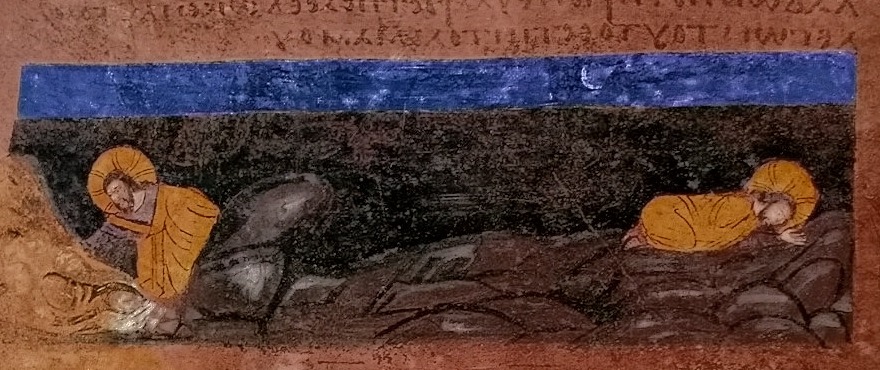
His emotional life is equally real. Jesus weeps at Lazarus’s tomb (John 11:35). In Gethsemane, the place where he prays on the night of his arrest, he is distressed and deeply grieved. He asks the Father to remove the cup, the suffering that lies ahead, and then yields to the Father’s will (Mark 14:32–36).
The desire to escape an agonising death is understandable. The obedience lies in what Jesus does with that desire. His prayer allows us to hear the strain under which his faithfulness is lived.
Christians have explained the relationship between these human limits and the Son’s divinity in different ways. In 451, the Council of Chalcedon, a gathering of bishops called to settle disputes about how to speak of Christ, affirmed that Christ was fully divine and fully human, “made in all things like us, sin only excepted.” The statement holds both claims together, though it does not explain every detail of how they relate.
A humanity we can recognise
This distinction matters beyond a debate about a word. If we treat tiredness, fear, and the need to learn as moral failures, we may feel guilty simply for being human. The Gospels give us reason to question that guilt. Jesus knows bodily need and emotional distress while remaining faithful to God.
We still have to examine how we respond to our limits. Exhaustion can explain why patience is difficult; it does not excuse cruelty. Fear can explain hesitation; it does not make betrayal harmless. Recognising a limit helps us understand the responsibility we face within it.
Our reading of Jesus needs the same care. We must take his humanity seriously and examine the claim of his sinlessness in light of what the passages actually say.
The chalice is still on the table, and so is that slippery word, “imperfect.” How easily we raise a glass to a perfect Jesus, then quietly remove everything that makes a human life human. Before we drink to that version of perfection, there is more to examine. Was his firmness with his mother a fault? Was his anger in the temple a sin? Why would he curse a fig tree for bearing no fruit out of season? And what should we make of the mother who answered him back?
In Part Two, we will follow those questions to Cana, the temple, the withered fig tree, and the region of Tyre, where a mother asks Jesus to heal her daughter.
Continue to Part Two: The Passages That Trouble Us.
Sources for Part One
- Scripture quotations are from the New Revised Standard Version. Biblical references appear beside the passages discussed.
- Council of Chalcedon, Definition of the Faith (451). Read the definition.