The Passages That Trouble Us
Bring the chalice to the table. This second sip has an edge to it. Jesus speaks of dogs to a mother who has come asking him to heal her daughter. The words remain, however carefully we turn the page. How convenient to have Jesus acquitted or convicted before the woman has even finished speaking. Apparently, hearing the evidence is optional. The encounter deserves a closer reading. What does she ask? What does he say? And what happens when she answers?
Part One argued that human limitation and moral failure are different things. The New Testament presents Jesus as growing, suffering, and facing temptation while remaining without sin. Here we bring that distinction to Cana, the temple, the fig tree, and the encounter near Tyre. It gives us a starting point and leaves us responsible for reading each passage closely.
I read these stories within that New Testament confession of faith. My argument is that they do not establish Jesus’ moral failure. A careful reading must attend to their language and setting and leave their difficulty where the text leaves it.
Cana and the words to his mother
At the wedding in Cana, the wine runs out. Jesus’ mother brings the problem to him. He answers, “Woman, what concern is that to you and to me? My hour has not yet come” (John 2:4).
In English, this can sound dismissive. Readers may wonder whether Jesus has broken the commandment to honour his parents. We need to consider both the way he addresses his mother and the question he asks.
“Woman” is also how Jesus addresses the Samaritan woman at the well and Mary Magdalene in the garden (John 4:21; 20:15). He uses it again when, from the cross, he entrusts his mother to the beloved disciple’s care (John 19:26–27). The word itself does not establish contempt. Its use by a son speaking to his mother is unusual, and we should allow that distance to register.
Jesus’ question sets a boundary around their involvement in the problem. He connects that boundary with his “hour.” Later in John, that word refers to his death and glorification, the revealing of his divine glory (12:23; 13:1). Within the whole Gospel, the exchange suggests that his work and its timing belong to his relationship with the Father.
Luke presents a related tension when the twelve-year-old Jesus remains in the temple. His parents are distressed, and his answer refers them to his Father’s house. Luke then says that he returns to Nazareth and is obedient to them (2:48–51). Loyalty to God and care for his parents remain together in the story.
Mary’s response at Cana also matters. She tells the servants to follow Jesus’ instructions (John 2:5). John does not tell us everything she feels or understands. He shows her continuing to trust Jesus with the situation, and Jesus goes on to provide the wine.
The later scene at the cross confirms his concern for her welfare. Taken together, these passages support a reading of Cana as a firm statement about his calling. They give us no clear account of a son treating his mother with contempt.
The temple and the question of anger
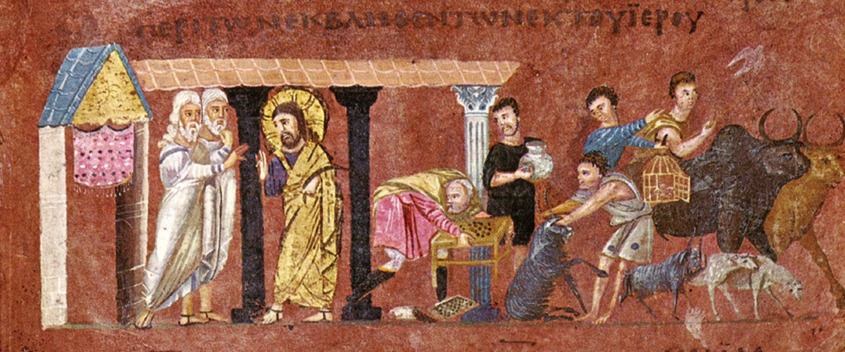
All four Gospels describe Jesus disrupting trade in the temple (Matthew 21:12–13; Mark 11:15–17; Luke 19:45–46; John 2:13–17). Merchants in the temple courts sold animals for the sacrifices, and money changers sat at their tables (Mark 11:15; John 2:14). The action is forceful. Tables are overturned and people are driven out. John also mentions a whip of cords. The question is whether the Gospel writers present the scene as an uncontrolled outburst or a deliberate act of judgment.
Mark gives us a revealing sequence. Jesus visits the temple, looks around, and leaves for Bethany, a village just outside Jerusalem, because it is late (11:11). He returns the next day. The disruption follows an earlier visit, which gives us reason to see it as deliberate. Mark does not tell us what Jesus thought overnight.
Jesus explains his action through Scripture. He draws on Isaiah’s vision of a house of prayer for all nations and Jeremiah’s accusation that the temple has become a den of robbers (Mark 11:17; Isaiah 56:7; Jeremiah 7:11). His action resembles those of Israel’s prophets, who sometimes made their message visible. Jeremiah, for example, broke a clay jug as a sign of judgment (Jeremiah 19).
John’s wording about the whip allows discussion about exactly who or what was driven out with it. John says that Jesus “drove all of them out of the temple, both the sheep and the cattle” (2:15). “All of them” may mean only the animals, or the traders with them. The account includes sheep and cattle, and no Gospel explicitly says Jesus struck a person.
That absence does not make the whole event gentle. It does caution us against adding blows that the text never reports.
Even if Jesus is angry here, anger alone does not settle the question of sin. Mark explicitly describes him as angry elsewhere. In a synagogue, people watch to see whether he will heal on the sabbath. Jesus is grieved by their hardness of heart, and he restores the man’s withered hand (Mark 3:1–5). His anger accompanies care for a person whose suffering others are willing to use against him.
Ephesians distinguishes anger from sin: “Be angry but do not sin” (4:26). Jesus’ own warning in Matthew 5:21–24 is severe: anger and contempt belong under the commandment against murder, and reconciliation is urgent. That warning also raises an uncomfortable question about our own anger, particularly the anger we are quick to call righteous.
Read alongside Mark 3, however, it is difficult to claim that every experience of anger is inherently sinful. The object of the anger, its expression, and its relationship to another person’s good all matter.
Matthew adds that the blind and the lame come to Jesus in the temple and he heals them (21:14). The Gospel places restoration beside judgment. I read the temple action in that setting, as a prophetic challenge to the misuse of God’s house. Calling it a temper tantrum assumes an account of Jesus’ inner state that the narratives do not supply.
The fig tree on the road from Bethany
Mark sets another troubling scene on either side of the temple action. On the morning Jesus returns to the city, he is hungry. He sees a fig tree in leaf and goes to look for fruit. He finds nothing except leaves, and Mark adds, “it was not the season for figs.” Jesus says to the tree, “May no one ever eat fruit from you again” (Mark 11:12–14).
He then goes into the temple and overturns the tables. The following morning the disciples pass the tree again and see it withered to its roots. Peter says, “Rabbi, look! The fig tree that you cursed has withered” (11:20–21). Matthew tells the episode more briefly, after the temple action, and has the tree wither at once (Matthew 21:18–20).
Read on its own, the story can sound like hunger turning into temper. Jesus looks for fruit the tree could not have produced and then condemns it. A tree is punished for being a tree in the wrong month. If that is the scene, it is fair to ask whether Jesus sinned.
Mark’s own remark points the reader elsewhere. By telling us the figs were out of season, he shows that he knows the tree has done nothing unusual. A writer who wanted us to share Jesus’ disappointment would hardly add that detail. I take it as a signal that the story concerns something larger than a tree and a hungry man.
Israel’s prophets used the fig tree as an image of God’s people. Shortly after the passage Jesus quotes in the temple, Jeremiah speaks for God about a people who bear no fruit: “there are no grapes on the vine, nor figs on the fig tree; even the leaves are withered” (Jeremiah 8:13). The cursing belongs with the prophetic signs discussed above, such as Jeremiah’s broken jug. A tree in full leaf promises fruit. The temple, busy with its trade and sacrifices, has the appearance of devotion. Jesus comes looking for the fruit God desires and finds leaves.
Leaves can promise fruit that the branches do not hold. Mark sets the tree beside the temple so that we can see one in the other.
His hunger is real. Part One treated hunger as a limit that carries no blame, and Mark attaches none to it here. Mark also names no frustration or anger in Jesus at this moment. To read the curse as a fit of temper, we would have to supply a feeling the text never mentions.
One caution belongs here. The withered tree must not become a verdict against the Jewish people. Jesus speaks as Jeremiah spoke, a Jew warning his own people about the use of God’s house. When Peter points to the tree, Jesus answers with teaching on faith in God, prayer, and forgiveness (Mark 11:22–25).
Luke does not record the cursing. He does record a parable about a fig tree that has borne no fruit for three years. The owner wants it cut down, and the gardener asks for one more year to dig around it and feed it (Luke 13:6–9). Luke’s parable places patience beside judgment.
The mother near Tyre
The encounter with the Syrophoenician woman (Phoenician by birth, from the Roman province of Syria) may be the hardest passage in this discussion. Mark identifies her as a Gentile, a woman outside the Jewish community, and places the meeting near Tyre (7:24–30). She comes to Jesus because her daughter has an unclean spirit, Mark’s phrase for a demonic power that torments a person.
Jesus says the children should be fed first, then adds, “it is not fair to take the children’s food and throw it to the dogs.” The woman answers that the dogs under the table also eat the children’s crumbs. Jesus accepts her reply and tells her that her daughter has been delivered (Mark 7:27–29).
Matthew’s account begins more sharply. Jesus is initially silent, and he states that his mission is to the lost sheep of Israel. It ends with his praise of the woman’s faith and the healing of her daughter (Matthew 15:21–28).
The difficulty is real. A mother from outside Israel asks for help, and Jesus places her on the dogs’ side of the comparison. Historical context does not remove the sting. Any interpretation must also take seriously her persistence and the force of her answer.
Some readers understand the exchange as a test of faith. On this reading, Jesus intends to heal the daughter from the beginning and draws out the woman’s response. Matthew’s praise of her faith supports this possibility. Neither Gospel explicitly says that a test was Jesus’ intention. It remains an interpretation.
Another reading focuses on the order of Jesus’ mission. Mark’s word “first” matters: Israel receives priority, but others are not necessarily excluded. Matthew makes the focus on Israel explicit. The woman responds using Jesus’ own picture of a meal. Children can be fed while dogs receive crumbs beneath the table. Healing her daughter need not take anything away from Israel.
The Greek word translated “dogs” is a diminutive, a form often used for small dogs. The picture is of a household table. That helps explain the image, but it does not make the comparison affectionate. Translating the word as “puppies” cannot tell us what tone Jesus used.
A third reading places the woman’s contribution at the centre. In Mark, Jesus responds directly to her argument. He tells her, “For saying that you may go” (Mark 7:29). Her words matter to the outcome of the encounter. She takes Jesus’ image of the children’s bread and the dogs beneath the table and turns it into an argument for her daughter’s healing. She is doing more than waiting for Jesus to finish speaking. She engages him, reasons with him, and receives a response.
The further claim that the woman corrects Jesus for prejudice needs separate consideration. Listening to another person and repenting of wrongdoing are different acts. Someone can hear a compelling argument and respond to it without first having committed a sin. Luke has already described Jesus as growing in wisdom.
The encounter can therefore be read as Jesus responding to the woman’s faith and reasoning within a mission whose first focus is Israel. That reading takes his humanity seriously. It allows her words to matter without making moral guilt a necessary explanation of his response.
Neither account records an apology or an admission of wrongdoing. That absence does not prove Jesus innocent. Equally, the hard comparison does not reveal his intentions or prove that he despises her. The story gives us a troubling saying, a strong reply, and a child healed.
Mark’s wider sequence adds another dimension. This encounter follows teaching about what makes a person unclean before God (7:14–23). Jesus then travels through the Decapolis, a region with many Gentile residents. The next feeding story, in which Jesus feeds four thousand people, ends with seven baskets of bread left over (7:31; 8:1–10). The woman asks for crumbs; soon the story speaks of abundance. I read that sequence as consistent with mercy reaching beyond Israel’s boundaries.
Some discomfort remains. Faith does not require us to pretend that these words are easy. I believe the encounter can be read consistently with Jesus’ sinlessness while taking seriously both his human response and the woman’s ability to speak and act for herself. To say he sinned requires more than the fact that this passage troubles us.
Four other questions
Jesus’ baptism raises another question. John the Baptist’s baptism is associated with repentance, so why does Jesus receive it? Matthew records John’s objection and Jesus’ answer that they should “fulfil all righteousness” (3:13–15). Jesus understands his baptism as part of fulfilling God’s purpose. The story records no confession of sin by Jesus. I understand his baptism as solidarity with those he has come to save and as obedience to his calling.
Then there is his question to the man who calls him good: “Why do you call me good? No one is good but God alone” (Mark 10:18). Jesus directs attention to God as the standard of goodness. The question does not contain a confession of wrongdoing. Reading it as such adds a conclusion the verse does not state.
His denunciations of religious leaders are also severe. Matthew places his warning about calling someone a fool beside his later description of leaders as “blind fools” (5:22; 23:17). The tension deserves attention. In Matthew 23, he publicly identifies hypocrisy and the neglect of justice and mercy. The chapter ends with lament over Jerusalem (23:37). I read these words as prophetic judgment joined to grief. They should make us careful about claiming permission for our own contempt.
Finally, the cry from the cross asks why God has forsaken him (Mark 15:34). These are the opening words of Psalm 22, a prayer that gives suffering a voice before God. Quoting a psalm does not make Jesus’ anguish less real. It does show that the cry belongs within prayer. Lament can express faith under unbearable strain.
Why the distinction matters for us
Confusing limitation with sin can burden people with guilt for the wrong things. Needing help can seem like failure; grief can feel like faithlessness; uncertainty can be mistaken for disappointing God. Jesus’ humanity challenges those judgments.
Genesis calls the created world very good (1:31). Human beings belong to that creation, and their goodness never requires them to possess God’s unlimited capacities. Sin damages human life. It does not define everything that makes us human.
Gregory of Nazianzus, an early Christian theologian, defended Christ’s full humanity in his letter to Cledonius: “that which He has not assumed He has not healed.” To “assume” here means to take on and make one’s own. His immediate concern was the human mind. Gregory was answering Apollinarius, who taught that in Christ the divine Word took the place of a human mind. If Christ did not have a human mind, an essential part of our humanity would be left out of the humanity he took on and healed. His argument warns us against describing Jesus as human while stripping away what makes human life real.
We can also make the opposite mistake and use our limits to excuse wrongdoing. “I’m only human” can become a way of avoiding responsibility for deceit or cruelty. Jesus’ sinlessness calls that excuse into question. Being human gives us needs and vulnerabilities; our conduct within them still matters.
Hebrews connects Jesus’ sympathy with us to his experience of being tested and invites us to seek mercy and help (4:15–16). C. S. Lewis makes a related observation in Mere Christianity: resisting temptation reveals how strong it is. Jesus’ faithfulness does not prevent him from understanding that pressure. It helps explain why we seek his help.
The psalmist says God remembers that we are dust (Psalm 103:14). There is compassion in that knowledge. We need not confess being creatures as though creaturehood were an offence.
The difficult passages remain on the page. Jesus speaks firmly to his mother, disrupts the temple, curses a fig tree, and responds to a foreign mother who presses her daughter’s need upon him. Elsewhere he grows, weeps, and faces death in anguish. His humanity has its full weight throughout. The New Testament’s confession stands: he is without sin.
A lamb without blemish is still a lamb.
The chalice is back on the table. We have examined the words to his mother, the overturned tables, the withered fig tree, and the crumbs beneath another mother’s table. The cup still holds a difficult question. How quickly do we declare Jesus guilty, or clear him of every difficulty, before hearing the woman’s reply? If a sinless Jesus could grow, listen, feel anger, and suffer, what kind of perfection have we been defending, and what kind of humanity are we willing to recognise?
Sources for Part Two
- Scripture quotations are from the New Revised Standard Version. Biblical references appear beside the passages discussed.
- Gregory of Nazianzus, Letter 101, to Cledonius, against Apollinarius. Read the letter.
- C. S. Lewis, Mere Christianity, Book III, Chapter 11, “Faith.” Read the chapter.
- The discussion of the Greek word for dogs also draws on the NET Bible translators’ notes on Mark 7 verse 27.