
Who governs the reading? A Christian reflection in two parts
Read first Part One: That’s Just Your Interpretation
Part One argued that Scripture has meaning we receive, that difficulty is real, and that some readings twist what has been written. Speculate with me about what does the twisting. We have brought excellent questions for the people who disagree with us. How many are we prepared to answer ourselves?
What Part One left on the table
Every reader brings something to the Bible: a language, a culture, a family, a church, a politics, a wound. Nobody reads from nowhere. Part One did not ask anyone to pretend otherwise. The question is what happens next. What we bring can help us notice something in the text we had missed. It can also take over the reading, so that the passage is allowed to say only what we already believed. That can become syncretism when beliefs or practices drawn from elsewhere compromise the faith we have received.
How does syncretism distort the church’s understanding of Scripture?
Syncretism sounds like a word for someone else’s church. Eric Maroney gives the broad definition in Religious Syncretism: “Syncretism occurs when one religion adopts, absorbs or otherwise accepts elements of another religion” (2006, p. 6). He examines how that borrowing changes the traditions involved. This definition describes a process. Christians must then ask whether the resulting beliefs and practices are faithful to the gospel.
Derek Brotherson makes this theological distinction in Contextualization or Syncretism? (2021, chapter 1). In the evangelical understanding he surveys, syncretism involves the incorporation of elements that compromise Christian faith. Those elements may come from another religion, but cultural values and political ideologies can also distort Christian belief. The problem reaches beyond the borrowing of religious ceremonies.
This matters for biblical interpretation. A reader may consult philosophy, psychology or another field to understand a question more fully. These resources can provide useful knowledge, and their claims remain open to examination. The line is crossed when we give an outside system the authority to decide what Scripture is permitted to teach. If we accept a passage only after reshaping its meaning to fit convictions or preferences we refuse to question, we have given those convictions or preferences authority over Scripture.
Paul warns against being taken captive by philosophy and empty deceit grounded in human tradition and the elemental spirits of the world rather than Christ (Colossians 2:8). His warning calls us to examine the particular teaching and its relation to Christ. When a system of thought determines in advance what Scripture may say, it has taken authority over the text it claims to explain.
Cultural expression requires discernment too. Translating Scripture into another language or singing in a local musical style does not, by itself, compromise the gospel. A borrowed spiritual practice raises further questions. What does it teach about God? On what basis does it promise access to God, spiritual power or salvation? Giving it a Christian name does not resolve those questions.
Brotherson presses this point in his conclusion: a practice can be directed toward the true God and still express false worship (2021, chapter 6). Sincerity and declared allegiance are insufficient tests. We must examine whether the practice sustains dependence on Christ or teaches people to rely on something that displaces Jesus’ sufficiency. He also argues that a practice’s use in another religion does not, by itself, settle whether Christians may use it. Its meaning and its effect on worship must be examined.
Paul’s treatment of food offered to idols shows why context matters. In 1 Corinthians 10, he permits believers to eat food sold in the market without raising questions of conscience about its origins (verses 25–26). He also forbids participation in idol feasts, describing such participation as incompatible with communion with Christ (verses 14–22). The food’s origin does not settle the question. Eating an ordinary meal and participating in worship involve different relationships and obligations.
Jesus exposes the danger of rival authority within religious tradition itself. In Mark 7:8–13, he confronts a practice through which people could withhold resources that should have supported their parents. A religious commitment was being used to evade God’s command. The passage addresses human tradition overriding divine authority rather than the blending of religions, but it exposes a failure that also permits syncretism: a devout community can authorize what God’s word calls into question. Our inherited church customs deserve the same scrutiny we give unfamiliar practices.
This is why biblical interpretation and the examination of syncretism belong together. We must read the whole argument, attend to the situation being addressed and distinguish what Scripture permits from what it forbids. An isolated verse can become an excuse for accommodation or a prohibition the passage itself does not support. Faithful interpretation must allow Scripture to correct both errors.
By this theological definition, syncretism hinders the church because it compromises the faith the church is entrusted to proclaim. It can preserve Christian vocabulary while changing what that vocabulary means. The gospel is news about what God has done in Jesus Christ, news we did not invent. When another authority governs its content, the church may turn that news into an endorsement of convictions it has already chosen. Christ may still be named while those convictions determine what the church or a person believes about him and what obedience to him requires.
We should therefore identify the actual contradiction when we call something syncretistic. Which belief has changed? Which practice conflicts with Scripture, and how? The charge deserves evidence. Respect for people requires that we represent their beliefs honestly; faithfulness to Christ requires that we judge those beliefs truthfully. Grace governs how we speak. It does not remove the obligation to discern.
When our own reading is tested
The shade is easy to aim at our opponents. It is harder to let it fall on ourselves.
The warning in Mark 7 cuts across every camp. A nationalist reading can govern Scripture. So can a Marxist reading, a therapeutic reading, a consumerist reading or an individualistic reading. A denominational tradition we have never questioned can govern it. Personal experience can govern it. Insights from these sources may sharpen our questions. None earns the right to dictate the answers. The test remains: does each source help us see what is actually in Scripture, or is Scripture being required to approve conclusions reached somewhere else?
Maroney also recalls a radio interview with an Iranian shepherd who contrasted prayer under the Shah with prayer after the Islamic Revolution. Under compulsion, “you could no longer be certain who prayed from conviction and who prayed from fear” (2006, preface). His account raises a question about conscience that reaches beyond Iran. Government pressure can compel religious conformity; it can also make people afraid to act on their faith. Outward conduct alone does not tell us whether someone is acting from conviction or fear.
The anecdote concerns coercion. It does not establish that every coerced act is syncretistic. The connection arises when political demands are given authority to revise Christian belief or to excuse what Scripture forbids. Fear may help explain a compromise, and it calls for compassion toward those under pressure. It does not make the compromise faithful.
No tradition is immune from self-deception, including the one that feels most like home. These questions help:
- Does a worldview help us ask better questions of Scripture, or does it decide in advance which answers we will permit?
- Does an idea serve understanding, or has it become the courtroom where Scripture must defend itself?
- How has our experience helped us notice something in the text, and where might it be preventing us from hearing what the passage says?
Back to the slogan
So, when someone says, “That’s just your interpretation,” what then?
Sometimes it is a fair warning. Interpreters make mistakes. Scholars disagree. Churches inherit assumptions they rarely examine. We should be slow to treat our reading as the voice of God.
“That’s just your interpretation” can also become a way out of the conversation. When someone says it, there is still work to do. Read the whole paragraph. Ask what kind of writing it is and what the words communicated in their first setting. Trace the passage’s place in the book and the wider Bible. Then compare the competing readings: which explains the evidence best, and what evidence would require us to change our minds?
Disagreement will remain, but these questions make it responsible. Where the evidence does not settle a difficult detail, we can acknowledge uncertainty without treating every proposed reading as equally persuasive.
Putting the reading to the test
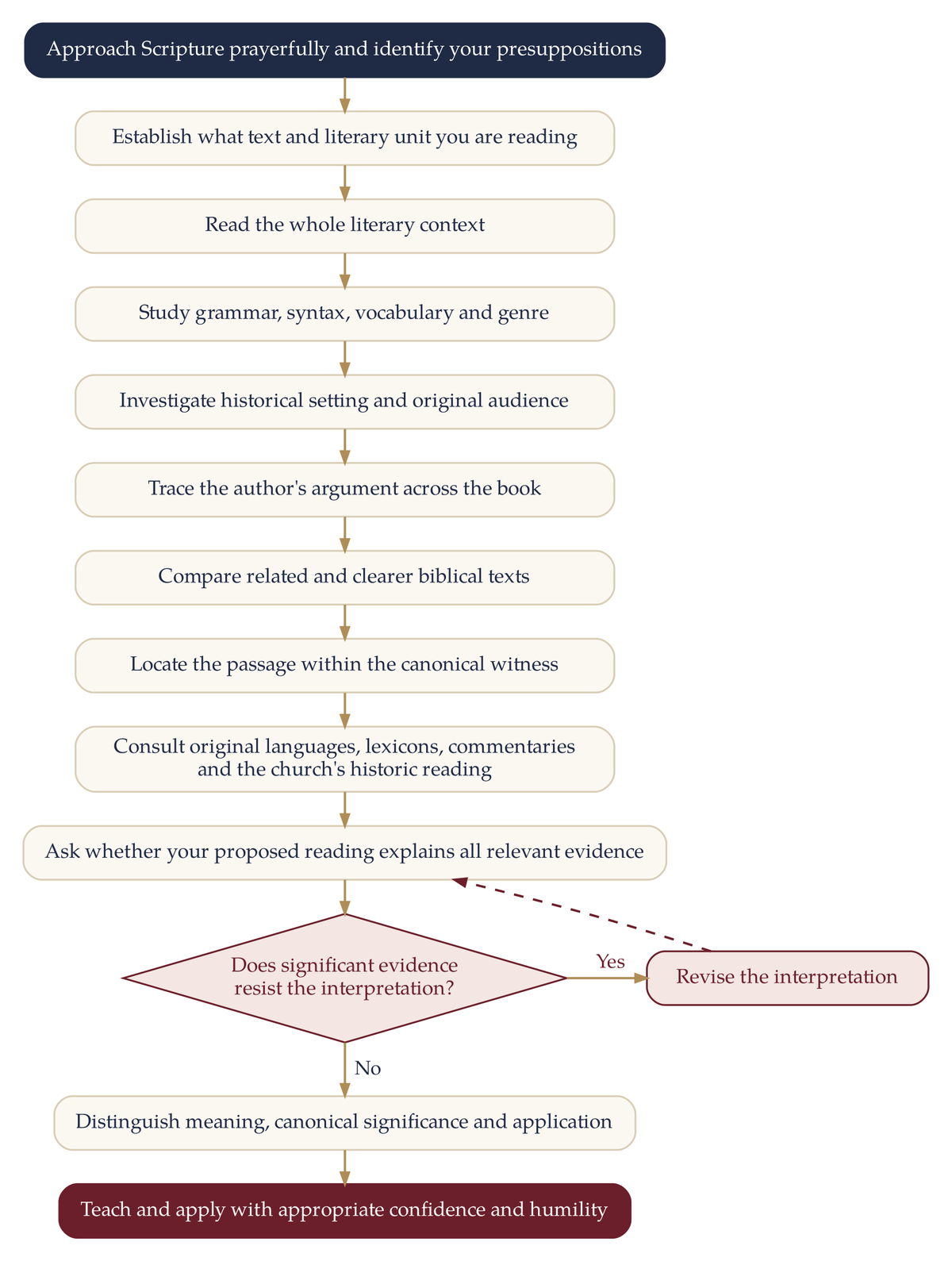
Figure 1 begins with prayer and an honest account of what we bring to the passage. Then we identify the complete passage we are reading, whether a paragraph, a poem or an episode, and read it within its wider context. Grammar, vocabulary, the kind of writing and its historical setting help us understand what those words communicated to their first audience. We trace the writer’s argument before comparing related passages and considering the passage’s place in the whole Bible. Where needed, commentaries and resources on the original languages help us examine our conclusions. The church’s historic readings also deserve consideration. These stages belong together; a cross-reference cannot excuse neglecting the paragraph in front of us.
The decision point asks whether significant evidence resists our interpretation. If it does, we revise our explanation and test it again. In 2 Peter 1:20–21, for example, a reader may take the familiar KJV wording about “private interpretation” as a ban on reading the Bible for oneself. The next verse requires us to test that reading carefully. It begins with “For” and explains that prophecy came from God as the Holy Spirit carried the prophets along.
We must also read the defence of the apostolic witness in verses 16–19. An explanation of verse 20 must account for both its immediate wording and that wider argument. The return arrow makes correction part of faithful reading. Reaching “No” means our reading has withstood these questions and accounts for the available evidence, although some details may remain unresolved. From that tested understanding, we consider how the passage addresses us. We distinguish its meaning, its place in the whole of Scripture and its application to our lives. We teach with confidence while keeping our conclusions open to correction.
It also helps to separate two claims. To say that Scripture has meaning is a claim about Scripture. To say that I have grasped that meaning perfectly is a claim about me. The first does not prove the second. Humility keeps hold of the possibility of truth, and it remembers the difference between the authority of the Bible and the fallibility of my reading of it. A rich text can carry many faithful applications and great depth without dissolving into whatever we prefer. Where readings directly contradict one another about the same claim in the same respect, they cannot both be true.
Unity of meaning does not require poverty of significance.
Readers who can be corrected
Scripture communicates meaning that the reader receives. Its words set boundaries. Its setting matters. Its place in the whole Bible matters. Some readings fit the evidence better than others, and some readings distort what has been written. We cannot make Scripture echo us, and we cannot pretend that we approach it without assumptions. Our task is to become readers whose assumptions can be corrected by the Word we have come to read.
A reading we can answer for
One last sip. If our reading has survived, let it survive with better reasons than the comfort of finding ourselves right again. Test the interpretation we carried in with us as carefully as the one we are being asked to consider. The question beneath interpretation is finally a question of discipleship: When Scripture and my preferred worldview pull in different directions, which one will I permit to correct the other?
The series Part One: That’s Just Your Interpretation
Bibliography and Translation Note
Biblical quotations are from the English Standard Version (ESV), unless another translation is identified.
Aquinas, T. (1964). Summa theologiae: Vol. 1. Christian theology (T. Gilby, Trans.). Blackfriars; McGraw-Hill; Eyre & Spottiswoode. See First Part, Question One, Article Ten, pp. 37–41.
Augustine. (2009). On Christian doctrine (J. F. Shaw, Trans.). Dover Publications. See Book Three, chapter 2, pp. 80–82, and chapters 26–27, pp. 103–104.
Brotherson, D. (2021). Contextualization or syncretism? The use of other-faith worship forms in the Bible and in insider movements. Pickwick Publications.
Maroney, E. (2006). Religious syncretism. SCM Press.
Vinson, R. B., Wilson, R. F., & Mills, W. E. (2010). 1 & 2 Peter, Jude. Smyth & Helwys Publishing.
Wells, A. R. (n.d.). When I read the Bible through. Poetry Explorer. https://www.poetryexplorer.net/poem26.php?pid=10139711
Westminster Assembly. (2011). The 1647 Westminster Confession of Faith and subordinate documents with the Authorized Version (C. M. McMahon & T. B. McMahon, Eds.). Puritan Publications. See chapter 1, sections 7 and 9.