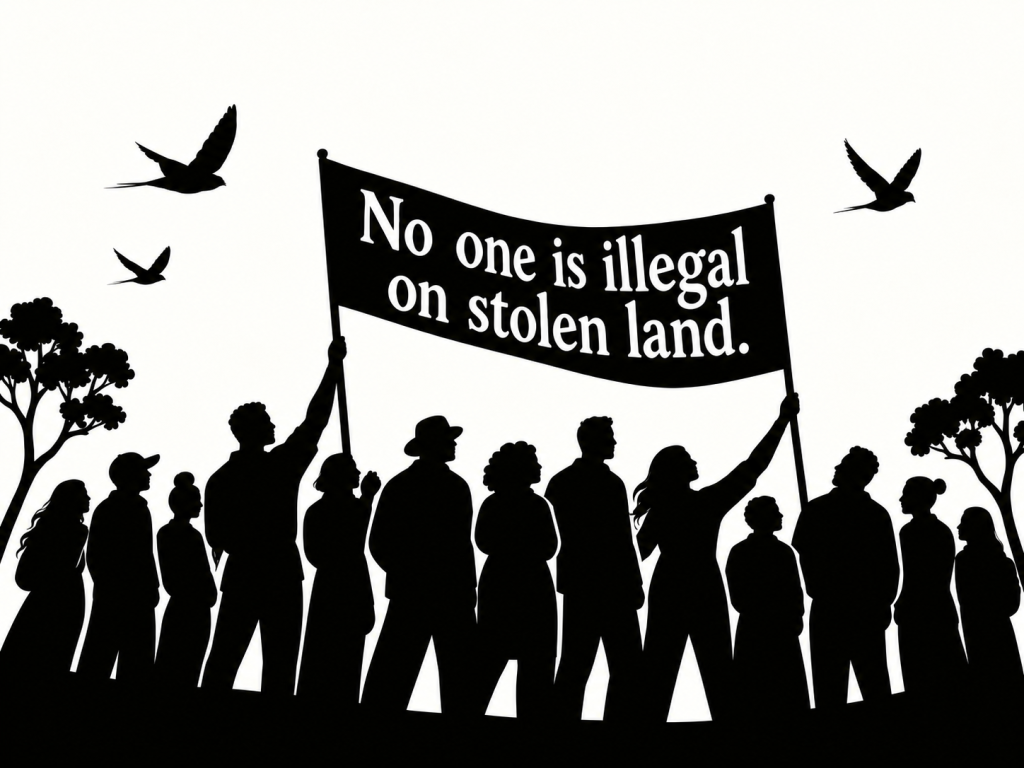
The truth inside the slogan
A Christian reflection in two parts
Pour this one into a clear tumbler. The sentence needs to be seen all the way through: “No one is illegal on stolen land.” There is truth in the glass, enough truth to make refusal sound callous. There is sediment too. If the land is stolen, who acquired the authority to hand out the keys? Sip carefully. The speculation begins where slogans usually prefer to end: what happens when human dignity, historical dispossession and present jurisdiction are pressed into seven words and served as though nothing remains to be argued?
Richard Lederer, who spent a career collecting the absurdities of English, liked to ask, “In what other language do people drive in a parkway and park in a driveway?” (Crazy English, 15). The question deserves a sequel. In what other slogan does a people declare the land stolen and then hand out the keys? The law has a name for someone who receives stolen goods and passes them along to others. That person is called a fence, an awkward word for a movement that would like to abolish them.
Lederer also delighted in anagrams, words whose letters can be shuffled into their own indictment:
The evil thoughts that live in us are vile and may cast a veil over us. Even Santa can turn into Satan and the United Nations into tainted unions, and the sainted become stained instead. Even your teachers can turn into cheaters and your mentors become a monster. (162–64)
Slogans can do the same to those who repeat them. A sentence meant to display compassion can end up concealing confused history, borrowed grievance and moral self-congratulation. Some sentences arrive already carrying a verdict, and “No one is illegal on stolen land.” is one of them. It begins with a necessary truth: no human being is illegal. It then moves toward a conclusion that cannot survive examination. In seven words it gathers migration, law, colonization, land and belonging, and presents the whole bundle as settled. It joins three different claims: one about the worth of a human being, one about the history of a territory, and one about the authority of a present state.
In Everything Progressives and Conservatives Know about Christianity: A Moderate Perspective (2025), I used satire to press at a related problem: political labels and slogans often arrive with a theology already packed inside them. The task is to unpack the sentence before the sentence decides the argument for us.
A faith community should pause before repeating such a sentence. Words spoken together, in a crowd or in a sanctuary, form the people who speak them. So the question I want to press is larger than whether the slogan is true. What kind of people are we becoming when we say these words, and what might we be excusing ourselves from when we say them? This first part traces where the words came from and sets out what is true in them. The second part examines what the slogan asks us to believe beyond those truths, and why the church should decline to believe it.
Two streams in one sentence
The first half of the slogan has a traceable origin. On 22 January 1985, Elie Wiesel gave the opening address at the Inter-American Symposium on Sanctuary in Tucson, Arizona, speaking to Central American refugees and to the churches sheltering them. He told them that no human being is illegal, that the phrase is a contradiction in terms, and he asked, “How can a human being be illegal?”
Wiesel spoke from memory. In the same lecture he recalled standing in the synagogue courtyard in Sighet, handing over the Hungarian citizenship papers his family had laboured to obtain, and watching an officer tear them up without looking at them. That was the moment he became a refugee. His claim concerned the person. A human being, he said, can be right or wrong, but cannot be illegal. The distinction is worth keeping: status belongs to the law, and the person belongs to God.
Wiesel carried that conviction into the political order. He urged his listeners to move American public opinion so that Congress would act, and he spoke hopefully of legislation associated with Senator Dennis DeConcini. DeConcini’s S. 2131, introduced alongside a parallel measure by Representative Joe Moakley, sought to suspend temporarily the deportation of certain Salvadorans while conditions in El Salvador were examined. The proposal died with the 98th Congress. Revived in the 99th, it died there too. Wiesel’s appeal matters here because he did not treat compassion and law as opposites. He appealed to law on behalf of refugees and expected the law itself to be changed when justice required it.
The phrase later travelled into migrant-justice movements, including the German campaign Kein Mensch ist illegal and related No One Is Illegal networks. The words “on stolen land” came afterward, emerging where arguments about Indigenous sovereignty, decolonization and opposition to state borders converged. Yet Indigenous sovereignty can itself entail claims of territorial authority, including authority over belonging, entry and movement. That is a claim to jurisdiction. It sits uneasily beside readings of the slogan that treat borders themselves as illegitimate, and I will return to that tension in the second part.
The sentence therefore carries two claims. Wiesel’s concerns the irreducible dignity of the person. The later addition concerns borders, state authority, colonial acquisition and Indigenous territory. The claims are related, yet distinct. Much of the confusion begins when they are treated as one.
No human being is illegal
The first claim is true, and Christians have older reasons than any slogan for holding it. Every person bears the image of God (Genesis 1:27). Israel was commanded to love the stranger because Israel had been a stranger in Egypt (Leviticus 19:33–34; Deuteronomy 10:19). The reason Scripture gives is memory: a people once made vulnerable as strangers must not reproduce that vulnerability against the stranger in their midst. The prophets set the sojourner beside the widow and the orphan as the measure of a nation’s justice (Jeremiah 7:6; Zechariah 7:10; Malachi 3:5). A person’s dignity is prior to citizenship, documentation, or permission to remain. To call someone “an illegal” lets a legal category swallow a human being, and Scripture gives us every reason to resist that reduction.
The legal distinction matters as much as the theological one. States regulate entry, residence, asylum, employment and citizenship. A person may lack status, may have entered without authorization, or may have remained after a visa expired. None of this makes the person illegal. They break a law. Particular acts can still be unlawful. Wiesel’s sentence protects the person while leaving the categories of lawful and unlawful conduct standing. That precision is its strength.
Here the first half of the slogan does real work. It refuses a dehumanizing word. The trouble begins when the refusal of the word is taken as a refusal of every moral question the word once covered so crudely.
Was the land stolen?
The phrase “stolen land” often meets a familiar objection: Indigenous peoples had no concept of ownership, so the land could not have been stolen. The argument depends on a narrow European idea of property, in which land counts as owned only when individuals hold it and can sell it.
Indigenous peoples are many distinct nations with distinct systems of land tenure. Territory could be held by a nation, clan, family or village, while particular people held defined rights to homes, gardens, fisheries, hunting grounds and gathering places. Relationship, stewardship and sacred obligation could live alongside territorial authority. Collective tenure is still tenure. The United Nations Declaration on the Rights of Indigenous Peoples recognizes this range by affirming rights to lands Indigenous peoples have “traditionally owned, occupied or otherwise used or acquired” (Article 26).
The Christian Scripture shows an example of stolen land. Naboth refused to sell his vineyard to King Ahab because it was the inheritance of his ancestors. Jezebel arranged a fast, two false witnesses, a trial and an execution, and Ahab walked in to take possession. Elijah met him there with the question, “Hast thou killed, and also taken possession?” (1 Kings 21:19). The dispossession was carried out through legal procedure. Law can be the instrument of theft, so an appeal to present legality settles nothing about how land was first acquired. It is also true that Elijah named a particular vineyard, a particular king and a particular crime.
That particularity matters. “Stolen” accurately describes land taken through violence, fraudulent agreement, forced removal, treaty violation, or occupation without consent. Each history still requires evidence. Ceded land, unceded territory, treaty land, negotiated sharing and disputed title are different categories. One adjective laid across a continent flattens them and can hide the distinct claims Indigenous peoples continue to advance concerning territorial title, treaty obligations, jurisdiction, restitution, continuing rights of use, and political authority.
Both halves of the slogan, then, contain something true. No human being is illegal, and land in settler societies was taken in ways that deserve the word theft. Neither truth tells us what to conclude about the border before us or the person who crossed it by breaking the law. The slogan supplies that conclusion in advance. Whether it has earned the right to do so is the question for Part Two.
Continue to Part Two: Having the cake and eating it.