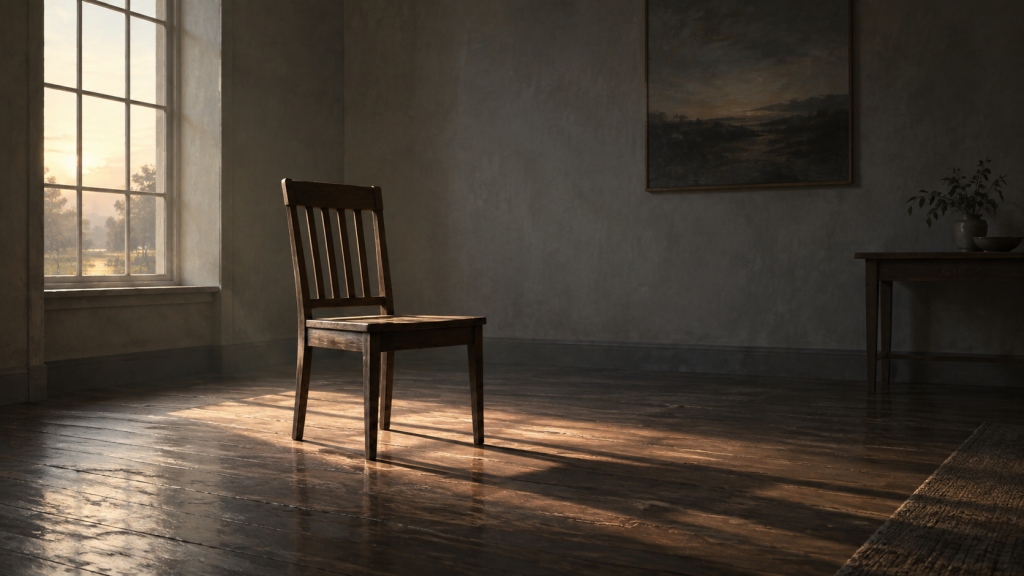
Consider this a glass of water poured before a meeting begins, the one people reach for while the agenda is still face down. Drink it slowly. The chair I imagined would not stay put, and it throws shade in every direction. It followed me into politics, classrooms, churches and courtrooms, and wherever it went, Christ troubled conservatives and progressives, the religious and the secular alike. So let us wonder together. Who is missing from this table? Who have we decided no longer deserves a chair? And have we left room for Christ?
I was preparing to open a meeting and found myself strangely unwilling to reach for the usual things. An invocation felt too expected. A prayer felt too easily spoken. A reflection risked becoming something we would hear, appreciate, and then leave behind as the agenda began.
So I imagined an empty chair.
At first, it was only a question for the people in the room: Who is missing from this table whose life may nevertheless be affected by what we decide here?
But the chair would not stay in the meeting.
It followed me.
Into politics. Into classrooms. Into churches. Into courtrooms. Into public debate. Into the arguments we are having about freedom, morality, identity, religion, justice, truth, and the kind of society we are becoming.
The question changed.
It was no longer simply, Who is missing from the room?
It became, Who have we decided no longer deserves a chair?
And then came the question I found harder to avoid:
Have we left a chair for God?
We live in a time when almost everyone speaks the language of inclusion, yet exclusion remains one of our most practiced arts. We decide which voices are enlightened enough to hear, which convictions are acceptable enough to express, which identities deserve public protection, which moral claims must remain private, and which forms of faith may enter the room without first apologizing for being there.
The empty chair began to look less like furniture and more like an accusation.
Yet religious freedom cannot mean freedom from Christianity while simultaneously meaning accommodation for everybody else. A genuinely plural society should have room for Christians, Muslims, Jews, Hindus, Sikhs, Buddhists, atheists, agnostics, and those who claim no religious identity at all. Equality cannot require one tradition to apologize for entering a public conversation while celebrating another for bringing its whole identity with it.
The answer to religious domination is religious liberty.
The answer to bad Christianity is better Christianity.
The answer to a plural society is a larger table.
So perhaps one of the empty chairs in our public life belongs to the Christian who has been persuaded that faithful citizenship requires silence.
Sit down.
Bring your convictions with you.
There is something deeply strange about a culture that celebrates authenticity and then becomes suspicious when a Christian is authentic about Christianity.
Of course, Christians have abused power. The historical record gives us no permission for innocence. Christianity has been enlisted in empire, racism, slavery, antisemitism, colonialism, misogyny, nationalism, violence, and the humiliation of human beings made in the image of God. Repentance belongs permanently among the disciplines of the church.
But repentance is different from disappearance.
A church ashamed of its failures must repent of its failures. It does not follow that the church should surrender its voice.
The prophets did not enter public life because they thought themselves morally superior. They entered because somebody had to say what everybody had learned to stop saying.
There are times when evil becomes respectable.
There are times when cruelty acquires sophisticated language.
There are times when greed calls itself freedom, vengeance calls itself justice, cowardice calls itself tolerance, and moral confusion advertises itself as enlightenment.
And there are times when goodness itself becomes embarrassing.
Faithfulness is called fanaticism.
Moral restraint is called repression.
Conviction is called intolerance.
Forgiveness is treated as weakness.
Human dignity becomes negotiable when the wrong human being is involved.
Truth becomes whatever survives the loudest argument.
We should be careful here. Every generation imagines itself capable of recognizing evil immediately. History suggests otherwise.
Evil rarely introduces itself by saying, “I am evil.”
It arrives with arguments.
It acquires experts.
It finds slogans.
It dresses itself in moral vocabulary.
It identifies enemies.
It assures us that ordinary rules of decency no longer apply because this situation is different.
Then good people learn to applaud things they once would have mourned.
This is why the empty chair matters.
Who is missing when we decide what is good?
Who is absent when we decide whose life has value?
Who has been removed before the conversation begins?
Who is no longer permitted to ask whether something is true, because the only acceptable question has become whether it is popular?
And perhaps most disturbingly:
Is Christ allowed in the room?
I do not mean a decorative Christ.
I mean the Jesus who asks what we have done to the least of these.
The Jesus who refuses to let religious people hide hypocrisy behind respectability.
The Jesus who tells the powerful that power is stewardship.
The Jesus who puts a child in the middle of adults arguing about greatness.
The Jesus who touches those respectable society avoids.
The Jesus who tells people they are forgiven and then tells them to change.
The Jesus who joins mercy to truth so thoroughly that neither can survive without the other.
That Christ is difficult to domesticate.
He troubles conservatives when conservatism becomes an excuse for indifference.
He troubles progressives when progress becomes incapable of admitting limits.
He troubles the religious when religion becomes performance.
He troubles the secular when secularism becomes its own unquestionable creed.
He troubles the powerful when they make themselves indispensable.
He troubles the wounded when pain becomes permission to wound others.
And he troubles all of us when we discover how easily we can see the speck in another person’s eye while constructing political, religious, and moral identities around the plank in our own.
The empty chair therefore cannot belong merely to the people with whom I agree.
That would make the exercise useless.
Perhaps the person sitting there is my opponent.
Perhaps it is the person whose politics make me angry.
Perhaps it is the immigrant I have reduced to a statistic.
Perhaps it is the unborn child whose dependence makes inconvenient demands.
Perhaps it is the woman whose fear has been flattened into somebody else’s ideological argument.
Perhaps it is the refugee.
Perhaps it is the police officer.
Perhaps it is the prisoner.
Perhaps it is the child being asked to navigate questions adults themselves scarcely understand.
Perhaps it is the religious believer told to become invisible.
Perhaps it is the unbeliever treated as though morality requires membership in my religion.
Perhaps the chair belongs to someone I have already decided does not deserve one.
That possibility should frighten us.
Christian moral reasoning begins with a stubborn claim: human beings do not manufacture one another’s worth.
We receive it.
The image of God comes before usefulness, politics, productivity, citizenship, ideology, sexuality, intelligence, innocence, guilt, agreement, or social approval.
That conviction places limits upon what we may do to one another.
Without limits, morality eventually becomes power wearing ceremonial robes.
Who decides what is good?
Who decides what counts as human dignity?
Who decides which freedoms are protected and which may be sacrificed?
Who decides which beliefs may enter the public square and which must remain behind closed doors?
A society may answer, “We decide together.”
Fair enough.
But then everyone must actually be allowed at the table.
Christianity cannot demand privilege. Neither should Christians accept banishment.
Pluralism worthy of the name requires disagreement.
Religious freedom worthy of the name protects religious expression precisely when somebody else finds that expression irritating.
Democracy worthy of the name requires citizens who can bring their deepest convictions into public conversation and still recognize the humanity of those who oppose them.
And Christianity worthy of Christ must possess enough courage to speak and enough humility to listen.
The empty chair has therefore become, for me, more than an image.
It is an examination.
Before I speak, who have I excluded?
Before I condemn, whose humanity have I forgotten?
Before I follow the crowd, what have I failed to question?
Before I call something progress, what have we left behind?
Before I call something traditional, what injustice might tradition be protecting?
Before I demand my rights, whose dignity will bear the cost?
Before I celebrate victory, who will be wounded by it?
Before I declare something good, by what measure have I called it good?
And before Christians complain that our culture has pushed Christ out of the room, we should ask whether we ourselves have left his chair empty.
Because invoking Christianity is easy.
Following Jesus remains difficult.
The chair is there.
Perhaps every parliament, boardroom, classroom, newsroom, church meeting, courtroom, family table, and social-media argument needs one.
Leave it empty for a moment.
Look at it.
Then ask the question we have become very good at avoiding:
Who should be sitting here, and what would they force us to remember?
And Christians should dare to ask one question more:
Have we left room for Christ?