Pour a cup of coffee and take a sip. There’s a power bill in this story, though you could read the market headlines and never know whose name is on it.
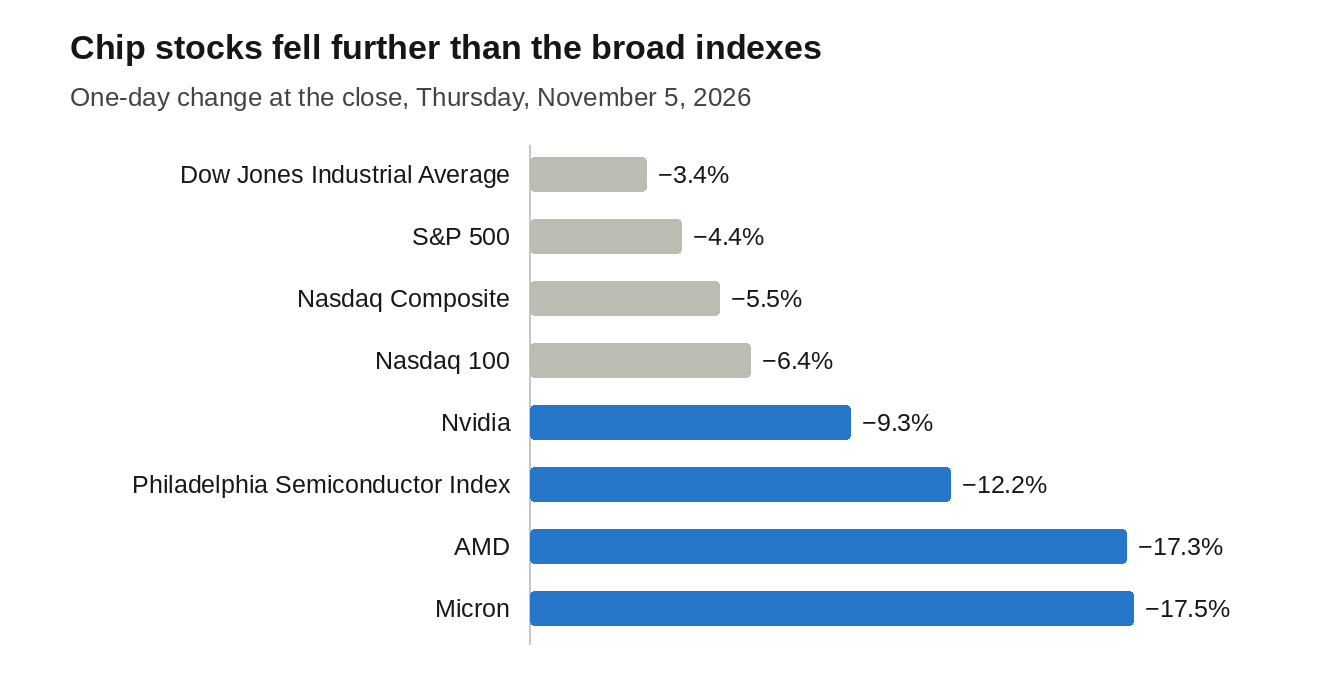
In Tuesday’s midterm elections, Democrats won control of both chambers of Congress for the coming term. Wall Street rallied on Wednesday. On Thursday the Nasdaq Composite fell 5.5 percent, its worst session since April 2025, and the Nasdaq 100 lost roughly $2.5 trillion in market value, by Reuters’ count. On Friday the Composite recovered 1.1 percent and remained in correction territory.
A data center can look inevitable on a spreadsheet. The spreadsheet has the advantage of never having to sit through a planning meeting. What happens to the money already committed if the permits take longer and the companies have to pay more for power? I can see four ways this might go.
What the market was pricing
Thursday’s sell-off put pressure on a familiar bet. Investors had been counting on AI data centers and the power infrastructure they need to be built on schedule, with borrowing helping to pay for it.
Voters are already anxious about their power bills. A June Reuters/Ipsos poll found that 77 percent of Americans worried AI would make electricity more expensive. An EPIC/AP-NORC survey published in September found that about six in ten favored limits on new data centers, with majorities in both parties. Five governors-elect campaigned on stopping or pausing data center construction, and two more pledged to extend pauses already in place. Bloomberg, citing Cleanview, reported that about 40 percent of planned U.S. data center capacity is in states where newly elected governors made such pledges. In Cleanview’s broader nine-state tally, Texas alone accounted for more than half of the capacity covered.
Public anger that hardens into policy can do damage that outlasts the anger. In 1930, Congress passed the Smoot-Hawley Tariff over the objections of more than a thousand economists. Other countries retaliated. By the end of 1934, the dollar value of world trade had fallen about 66 percent from its 1929 level. Economic historian Douglas Irwin argues that the tariff played a relatively small role in the Depression itself, though it contributed to the decline in trade and provoked discrimination against American exports. Three years later, the National Industrial Recovery Act allowed industries to adopt codes that relaxed antitrust constraints and set wage standards. Economists Harold Cole and Lee Ohanian estimate that the broader New Deal labor and industrial policies prolonged the Depression by about seven years. Each law was a political answer to real distress, and each, by these scholars’ accounts, carried economic costs.
The same risk now hangs over data centers. Campaign promises still have to become policy, and projects further out face greater exposure to new rules than those already under construction. Reuters reported that UBS expects potential pauses to slow construction into 2028, with about 30 percent of that year’s expected U.S. capacity additions at risk of being affected. Bloomberg Intelligence analyst Mandeep Singh estimated that the election results could trim 5 to 7 percent from the $1.4 trillion that technology companies were projected to spend on AI infrastructure in 2027.
Much of the money is borrowed. The International Monetary Fund’s October Global Financial Stability Report named a correction in AI-related assets as one of three major risks to global finance. Across 14 disclosed deals, it identified about $650 billion in debt alongside $1.4 trillion in commitments for future revenue. Some data center operators sign 15-year leases while their own customers commit for a few years at most. VanEck reported that some CoreWeave debt was trading at yields near 15 percent.
Four ways this could go
- The slow sort. Construction already underway finishes, and new projects wait. The largest cloud companies have the cash, power contracts and permits to keep building. That gives them more say over prices. Smaller rivals sell out or merge. Stocks recover unevenly, and the market ends up more concentrated than before. Households see little change in their bills for years. Of the four, this seems the likeliest to me.
- The credit break. A pause adds months of interest with no revenue to pay it. Friday’s report showed that U.S. employers added 165,000 jobs in October. Traders stepped up bets on a December rate increase. If it comes, refinancing gets harder at the worst moment. Say one heavily indebted operator fails. Its lenders take a hit, the chipmakers lose orders, and the cloud companies that counted on its business have to revise their forecasts. The IMF describes how losses can travel through these deals. When expected revenue falters, equity and debt can lose value together. Both were wagers on the same future. This could happen within eighteen months. It strikes me as the most dangerous of the four.
- The bargain. Companies agree to pay for their own power. Some build their own generation or accept permit conditions they once resisted. On Thursday, OpenAI renewed its pledge to cover the full cost of electricity and the infrastructure needed to supply it at future sites it owns and operates. Pauses could give way to permits with conditions attached. The build-out slows, and companies pick up more of the cost. This is the outcome I’d hope for. It depends on what regulators can enforce and what residents can see on their bills.
- The whiplash. A data center can be financed over fifteen or twenty years. A U.S. election can change the rules long before the debt is paid. Investors demand a higher return for that uncertainty or move their money abroad. Pressure builds for national rules to override local pauses, and the fight shifts to who gets to decide. This one could drag on for years.
I doubt this election alone will set off a 1929-style collapse. The IMF points to strong earnings among the companies leading the AI boom. Those earnings give the biggest firms room to absorb a delay. A smaller operator with interest due and a building waiting for power has less room.
I’d start with borrowing costs and permits. Here’s what I’ll be watching over the next few months.
| Signal | What to look for | Points toward |
|---|---|---|
| The Federal Reserve’s December decision | A rate increase | The credit break |
| The price of data-center operators’ debt | Yields climbing further; banks selling data-center loans | The credit break |
| Spending guidance from the largest cloud companies at their next quarterly results | Plans held steady while smaller rivals cut back | The slow sort |
| New industry commitments on power costs | Binding terms that regulators and voters can verify | The bargain |
| The first legislative sessions of 2027 | Pledges becoming law in some places and fading in others | The whiplash |
| Proposals in Washington to override local pauses | Bills gaining sponsors from both parties | The whiplash |
I had a business magazine open and a shot of Irish cream in my coffee when I thought of something I once heard a speaker say. As I remember it, the point was that entrepreneurs need room to build. They need reliable power, and they need to know the rules before they borrow the money.
I can see the force of that argument. A company can spend years getting a project ready to build. Is this the time to play politics with the rules? If borrowing gets more expensive while construction stalls, some operators may struggle to make their payments.
I can see why a business wants to know what it will cost to build. A household wants to know what it will cost to keep the lights on. In a few months, I’ll still want to see the power bill.